Medical Lift Chairs: What the Label Means and How to Buy One
“Medical lift chair” is a selling label, not a Medicare coverage category.
Medical-supply and DME dealers use it for power lift recliners they can bill as durable
medical equipment (DME). The difference from a retail recliner is not the label: it is the
treating practitioner’s order, the supplier’s Medicare enrollment, and the code
used for the seat-lift mechanism. Medicare Part B covers that mechanism — the
electrically operated one is HCPCS E0627 — not the chair. Buy the same kind of chair at
a furniture store or online and you pay the full price and need no order.
Medicare and coverage facts checked against CMS and Medicare.gov on 2026-11-14. Each fact
below links to the document it came from.
The four coverage criteria and the full payment rules are on the
Medicare lift chair page. This page covers the
label, the order, how DME supply differs from retail, and the fit and control features worth
comparing.
What makes a lift chair “medical”
Medicare’s own definition of durable medical equipment is the test that matters.
Medicare.gov defines DME as equipment that is:
“Durable (can withstand repeated use); Used for a medical reason; Typically only
useful to someone who is sick or injured; Used in your home; Expected to last at least 3
years.”
A power lift recliner is sold as DME when it is meant to be used in the home for a medical
reason, usually to help a person who cannot stand up from an ordinary chair. In the coverage
rules the clinical part of the product is the seat-lift mechanism, not the
upholstery and not the recliner feature.
The coverage documents describe a seat lift mechanism and the codes used to bill it. They do
not create a product class called “medical lift chair.” Article A52518 states
the two mechanism codes directly:
“A seat lift mechanism that is electrically operated is billed using HCPCS code
E0627. A manually operated seat lift mechanism is billed using HCPCS code E0629.”
When the mechanism is built into a chair and sold as one unit, the same article says the
supplier may bill the mechanism with E0627 or E0629 and bill the chair with A9270, the code
for a non-covered item. That is why a “medical” label does not make the chair
the covered item.
If Medicare is going to consider the seat-lift mechanism, yes. The supplier must have a
Standard Written Order (SWO) before a claim is submitted, and the order comes from the
treating practitioner or a consulting practitioner for the condition that creates the need,
not from the supplier or the chair store. LCD L33801 states the requirement:
“A Standard Written Order (SWO) must be communicated to the supplier before a claim is
submitted. If the supplier bills for an item addressed in this policy without first
receiving a completed SWO, the claim shall be denied as not reasonable and necessary.”
The practitioner’s record must also show that other treatments, such as medication and
physical therapy, were tried and did not enable the person to stand from a chair. None of
this is needed to buy a lift chair at retail: with no claim and no Medicare
involvement, the purchase is the same as buying any other recliner.
You may also read about the Certificate of Medical Necessity (CMN, CMS Form 849). Article
A52518 says suppliers no longer need to submit a CMN for claims with dates of service on or
after January 1, 2023. The Standard Written Order is the document that still has to reach the
supplier first.
Medicare covers the lift mechanism (E0627), briefly
The four coverage criteria, the 2026 CMS E0627 reimbursement math, and an interactive DME vs.
online cost comparison live on the
Medicare cost calculator.
The same search term leads to two different purchases. A DME supplier can bill Medicare for
the mechanism; a furniture or general online retailer cannot. Medicare.gov states the rule:
“Medicare will only pay for DME items if you get them from suppliers who are enrolled in
Medicare.”
A Medicare-enrolled DME supplier can submit a claim for the mechanism, so
it needs the Standard Written Order first. Ask two separate questions before delivery:
whether the supplier is enrolled in Medicare, and whether it will accept assignment on the
claim. Enrolling is required for payment; accepting assignment decides what you pay. The
chair and any upgrades, such as heat, massage or a premium fabric, are generally billed to
you as non-covered.
A furniture store or general online retailer sells the chair as a cash
purchase. There is no claim, no order needed, and no 20% coinsurance calculation: you pay
the listed price and choose the model, size and features. If you might want Medicare to
consider the mechanism, buying at retail closes that route for this purchase.
The enrolled Medicare supplier and treating practitioner prepare the written order and file the
Part B claim directly.
A medical label does not tell you whether the chair fits the person. These are the
specifications to compare, and what each one does.
Seat height. The coverage rule itself references seat height: LCD L33801
says that almost all beneficiaries who are capable of walking can get out of an ordinary
chair “if the seat height is appropriate and the chair has arms.” Treat seat
height as a fit measurement. A lower seat leaves the user further to rise; a seat that is
too high can leave the feet unsupported. In the six models on this page the published seat
height runs from 18 in to 22 in.
Weight capacity. Capacity is a published limit for the finished chair,
not the motor count and not a clinical judgement. Do not choose a chair rated at or below
the user’s weight; leave margin. Above roughly 350 lb, the
bariatric and heavy-duty page covers the higher tiers.
Positioning. Manufacturers label this as 2-position, 3-position, infinite
or lay-flat. More positions is not automatically better; what matters is which seated and
reclined positions the user will actually use. The table below prints each manufacturer’s
published position wording verbatim, describing the chair’s recline mechanics rather
than clinical outcomes.
The control. The coverage rule requires a mechanism that “can be
controlled by the beneficiary,” so the hand control is part of the fit. Check that
the person can reach and press it with the hand they have, and ask the supplier whether
the model has a battery backup for a power outage. This site’s model data does not
include control or battery details, so confirm both with the supplier rather than from a
listing photo.
Six models compared on fit, capacity and positioning
These are not “the medical ones.” They are the models already in this site’s
data file that show the range of seat heights, capacities, positions and motor counts
discussed above. Every value is the manufacturer’s or listing’s published figure.
We earn a commission if you buy through these Amazon links.
How we make money
Fit, capacity and positioning compared
Seat, capacity, position, motor, warranty and price for the six models.
On a narrow screen, scroll the table sideways to see every candidate.
Fit, capacity and positioning compared
Specification
MCombo 3 Motor Power Lift ReclinerModel 7631
FlexiSpot XL31 Power Lift ReclinerModel XL31
CANMOV Dual Motor Power Lift Recliner
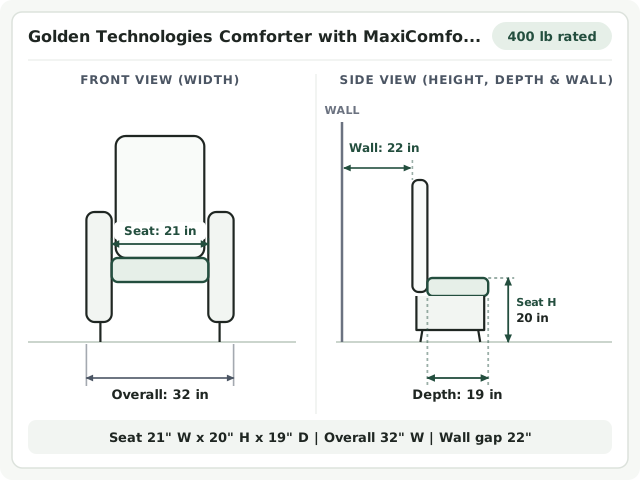
Golden Technologies Comforter with MaxiComfortModel PR535-PSA
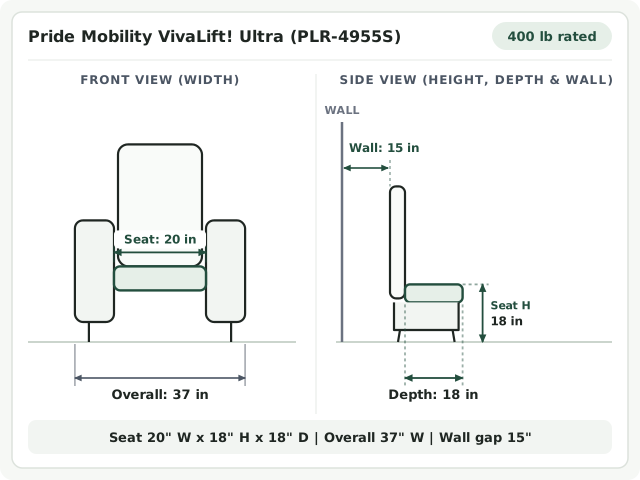
Pride Mobility VivaLift! UltraModel PLR-4955S
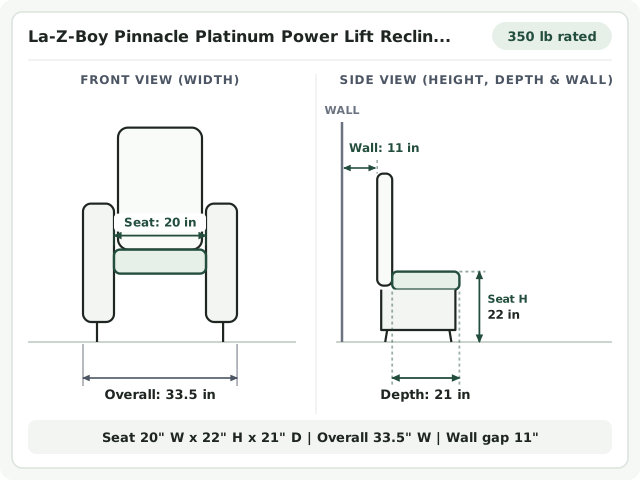
La-Z-Boy Pinnacle Platinum Power Lift Recliner with Headrest & LumbarModel 1PH512
Seat widthInside width between the arms. The most common reason a chair does not fit.
20.5 in
27 in
27 in
21 in
20 in
20 in
Seat heightFloor to the top of the seat cushion, with the chair seated.
20.5 in
22 in
20 in
20 in
18 in
22 in
Seat depthFront to back of the seat. Too deep and the knees never bend properly.
20.1 in
20 in
21 in
19 in
18 in
21 in
Weight capacityMaximum user weight published for the chair.
350 lb
400 lb
450 lb
400 lb
400 lb
350 lb
Positions
Infinite position; three motors adjust the headrest, backrest and footrest independently; reclines to 165° (lay flat)
Lay-flat recline to 165°; backrest and footrest move independently
Where to buy.
Models sold on Amazon have a Check price on Amazon button, and we earn a commission if you buy
through it. The rest are sold by the maker or through dealers, so their cards link to the
manufacturer’s page with the full specifications.
The models, one by one
Each card gives the published numbers, who the chair suits, and who it does not suit.
MCombo 3 Motor Power Lift Recliner (7631)
A 20.5 in seat and a 350 lb rating, with three motors that move the headrest, backrest and footrest separately. Published seat height 20.5 in.
Seat width
20.5 in
Seat height / depth
20.5 / 20.1 in
Capacity
350 lb
Positions
Infinite position; three motors adjust the headrest, backrest and footrest independently; reclines to 165° (lay flat)
Buying channel
Amazon
A 350 lb rating is the lowest on this page, and it needs 21.4 in of wall clearance.
Every Medicare and coverage statement on this page was read from the documents below on
2026-11-14. Product specifications come from the manufacturer or listing sources shown in the
table, each checked on its own recorded date. We do not estimate, round or infer a missing
value.
If the choice is really about size rather than coverage, start with the fit guides. If it is
about the coverage rules, read the Medicare page end to end.